

Renyuan LIU (刘稔远)
Nice to meet you here! I am a Research Master’s (MPhil) student in Artificial Intelligence at The Chinese University of Hong Kong, Shenzhen, supervised by Prof. Junjie Hu (School of Artificial Intelligence).
My current research focuses on AI infrastructure and AI agents.
I welcome collaborations across computer science. Curriculum Vitae · TEAM NEXUS
Research Interests & Selected AI Projects
My current research focuses on AI infrastructure and AI agents, with an emphasis on the efficiency and reliability of LLM systems.
- AI Infrastructure: efficient inference and training, accelerator adaptation, profiling, and kernel optimization;
- AI Agents: tool retrieval and planning, multi-turn context orchestration, memory, and evaluation.
100-Tool E-Commerce Shopping Assistant and Multi-Turn Tool Planning Agent System
View the complete project page
View project details
Project Background: As a core developer, I worked on an e-commerce shopping Agent spanning 100 tools and eight business domains, addressing full-tool overhead, confusion among similar tools, incorrect ordering of multi-intent requests, and cross-turn history contamination.
- Intent Routing (100.0% Classification Accuracy): Built 48K e-commerce and casual-conversation samples and LoRA-tuned Qwen3-0.6B, raising accuracy on 9,000 isolated test cases from 84.8% to 100.0%. Compared with Qwen3-1.7B, median inference latency fell by 34.3% and throughput rose by 52.0%.
- Efficient Tool Retrieval (97.4% Top-10 Full Tool Recall): Built 70K positive pairs and 96K typed negatives, fine-tuned bge-large with multi-negative contrastive learning, and trained bge-reranker-v2-m3 with 1:7 positive-to-hard-negative groups. Implemented dual BM25/vector recall, two-stage RRF fusion, and Cross-Encoder reranking with a “recall 40 → rerank 20 → plan 10” funnel. Top-10 full recall rose from 47.6% to 97.4%; compared with “rerank 30 → plan 20,” planner input tokens and median reranking latency fell by 36.8% and 33.7%.
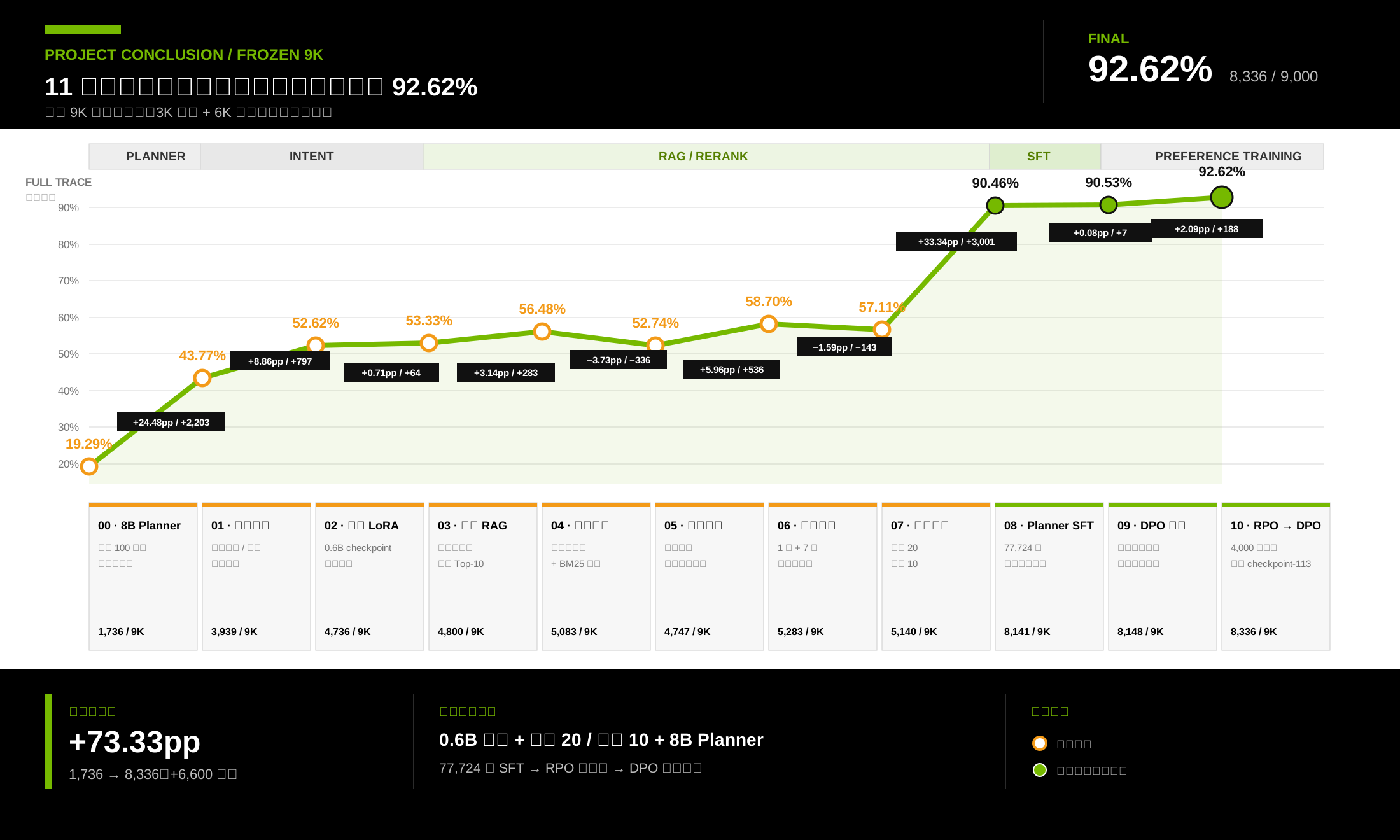
- Multi-Step Tool Planning (92.6% End-to-End Accuracy): Built 78K multi-style tool-call trajectories and LoRA-tuned Qwen3-8B with MS-SWIFT to output ordered tool chains from a fixed Top-10 candidate set. Constructed 4,000 preference pairs from real parent-model errors, using RPO for main training and low-learning-rate DPO for convergence. Exact tool-chain match improved from 85.7% to 88.9%, with 92.6% end-to-end accuracy on 9,000 static tests.
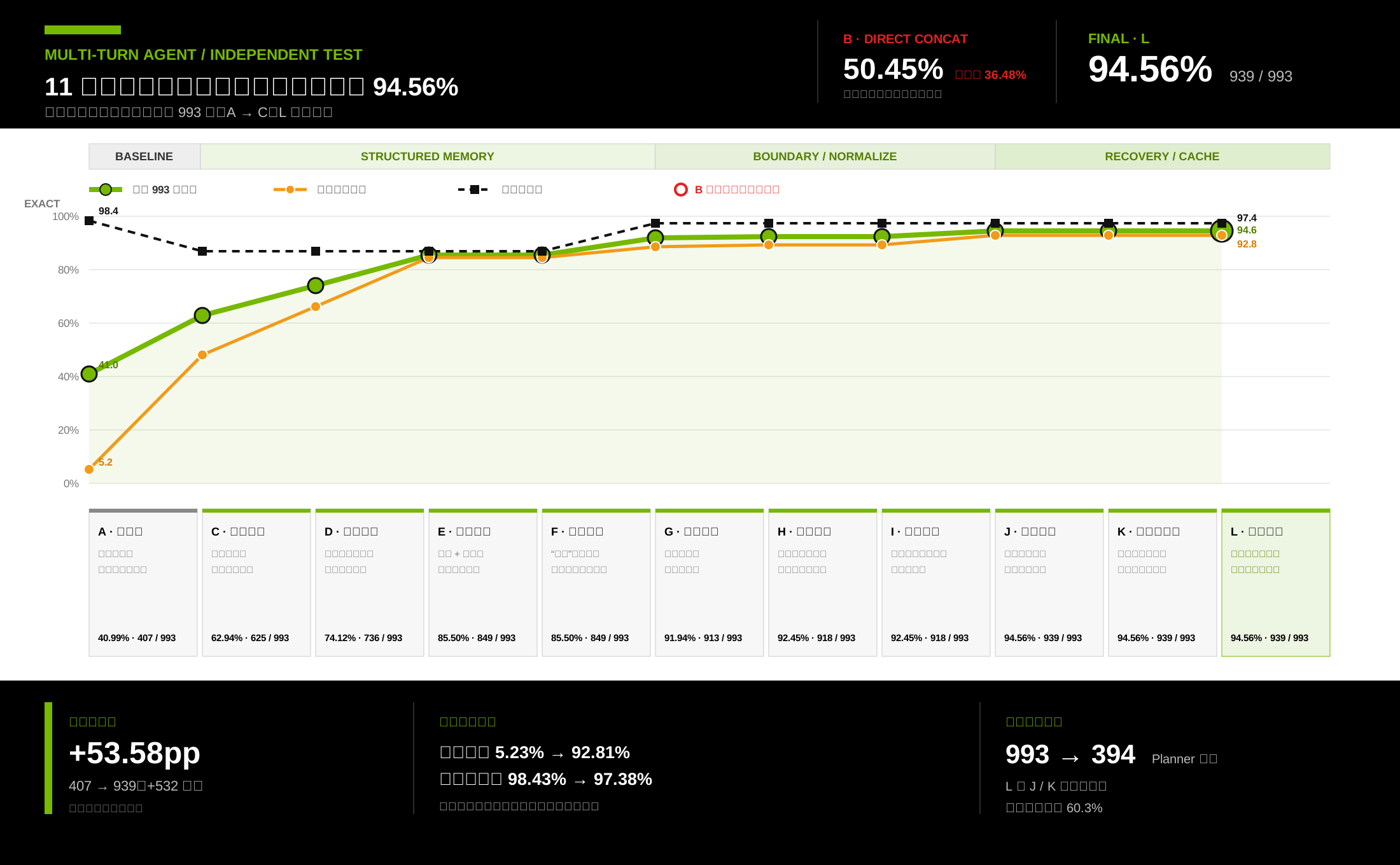
- Multi-Turn Agent Framework (92.8% Context-Dependent Request Accuracy): Designed an external context orchestrator whose rule-based state machine schedules recent state, rule summaries, and in-session BM25 retrieval. It compresses necessary history into a standalone current request before invoking the original planner, while request boundaries and full-turn recovery suppress history contamination. A 12-stage ablation on nearly 2,000 natural conversations of 2–7 turns raised independent-test overall accuracy from a 50.5% direct-concatenation baseline to 94.6%; context-dependent and context-independent request accuracy reached 92.8% and 97.4%, while version-validation caching reduced planner calls by 60.3%.
Core Results: 100.0% intent accuracy on 9,000 isolated tests; 97.4% Top-10 full tool recall (47.6% baseline); 92.6% end-to-end accuracy; 92.8% context-dependent request accuracy; and 60.3% fewer planner calls.
Project 1 | DeepSeek-V4 Domestic-Accelerator Adaptation and Ascend Kernel Optimization
View project details
Project Background: As a core developer, I participated in the full-parameter post-training of DeepSeek-V4-Pro on domestic accelerators, jointly conducted by Shenzhen Hetao College, Huawei, and 智子芯元. For DeepSeek-V4 inference and post-training on domestic hardware, I worked on Ascend 910C deployment evaluation, kernel-optimization Agent development, and fused backward-kernel optimization.
- 910C Inference Adaptation and Evaluation (DeepSeek V4 Flash/Pro): Participated in deploying and evaluating DeepSeek V4 Flash/Pro on an Ascend 910C cluster. Compared Prefill/Decode performance between vLLM Ascend and SGLang on ShareGPT and other datasets to support inference-framework selection and deployment configuration.
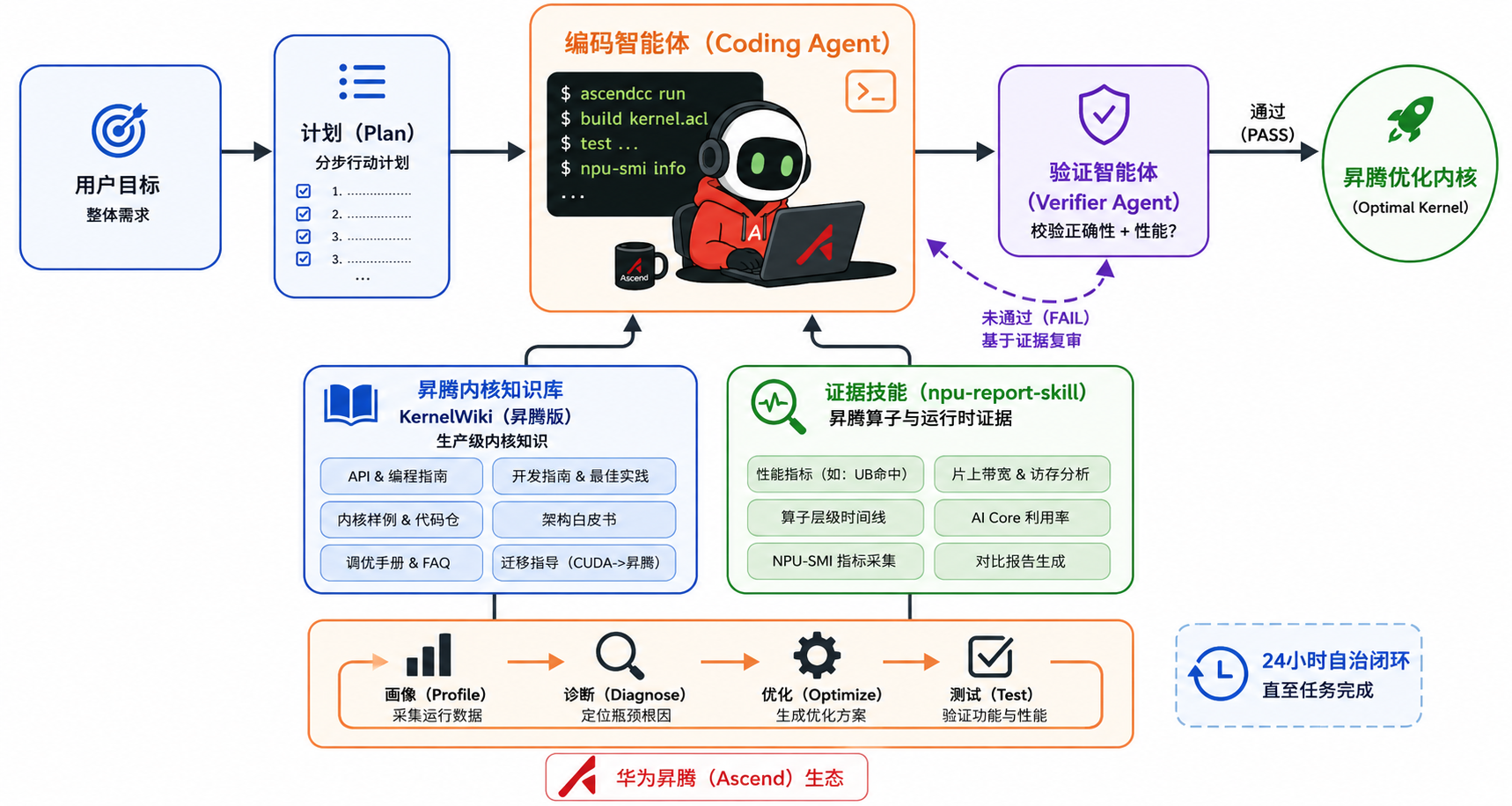
- Kernel Optimization Agent (Ascend Migration and Open Source): Addressed the manual analysis and repeated trial-and-error required by Ascend kernels by rebuilding MIT Kernel Design Agents for 910B/910C with a kernel knowledge base, optimization rules, and performance-diagnostic tools. Connected retrieval → generation → compilation → accuracy/performance verification → retain/rollback into a closed loop and open-sourced Kernel-Agent-Ascend.
- Fused Backward-Kernel Optimization (20.9% Lower Latency): Used msprof to locate scalar address calculation on AIV, sparse memory access, synchronization waits, and load imbalance. Simplified address calculation, pruned low-hit data-movement branches, removed redundant synchronization, optimized tiling/on-chip caching, redistributed vector tasks, and fixed tail-block out-of-bounds access introduced by cache expansion. Kernel latency fell from 22.603 ms to 17.88 ms (1.26×), while cosine similarity remained 1.0 for all four outputs.
Core Results: Under the target configuration (BSND/BF16, B=1, S=4096, K=1024), fused backward-kernel latency fell from 22.603 ms to 17.88 ms, a 20.9% reduction (1.26×). All four output cosine similarities were 1.0, with a maximum relative error of 8.39e-4.
News
[Jun. 2026] Founded TEAM NEXUS, a learning group.
[Jun. 2026] My undergraduate thesis received an Innovation Award and ranked 3rd university-wide.
[Mar 19th, 2026] Joined Shenzhen Research Institute of Big Data (SRIBD) as an Intern, working on AI agent development and large language model algorithms.
[Feb 27th, 2026] Admitted to the MSc program in Data-Centric Artificial Intelligence at The Hong Kong University of Science and Technology (Guangzhou), Data Science and Analytics Thrust!
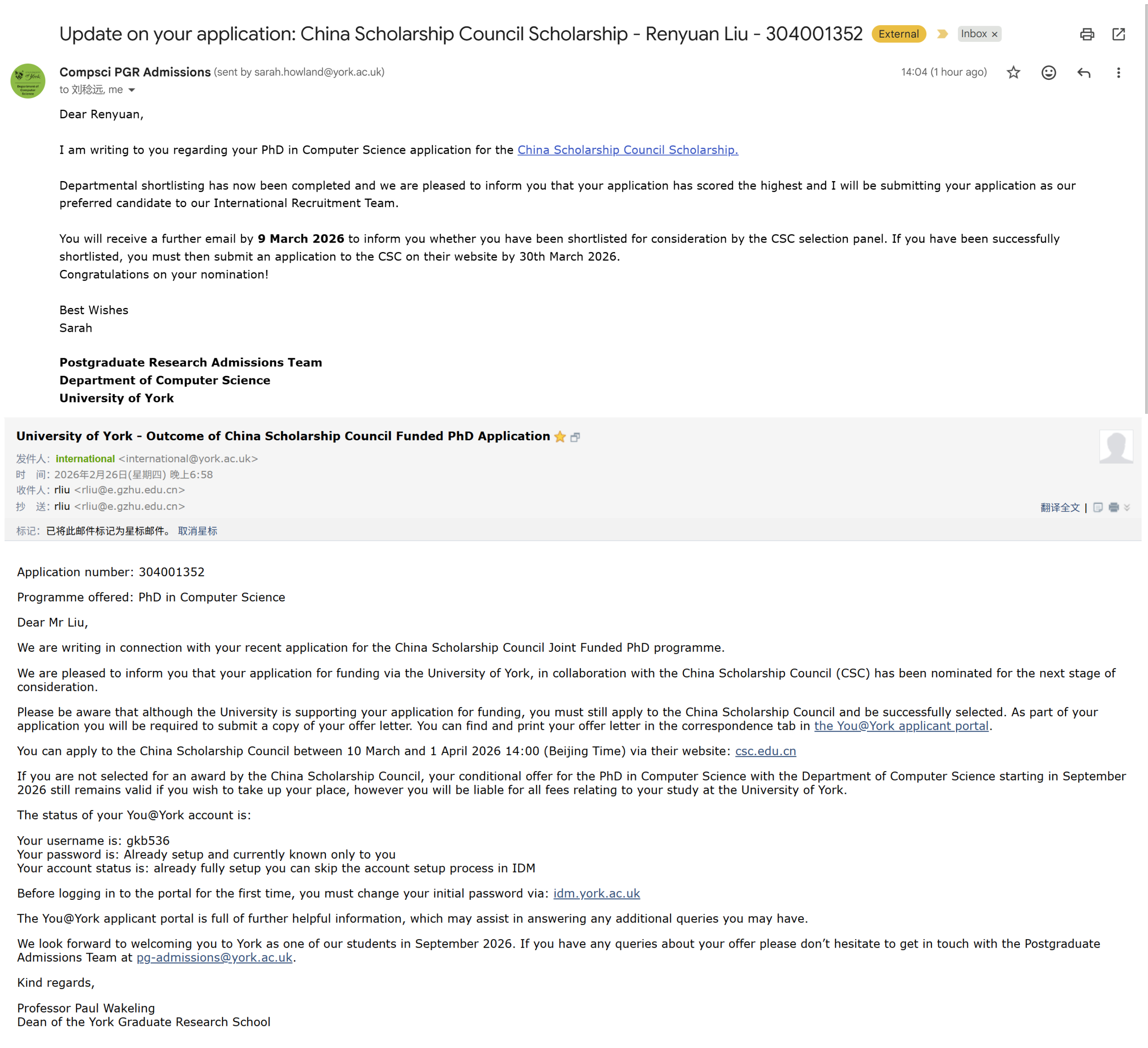
[Feb 26th, 2026] Scored the highest and nominated for the CSC Joint Funded PhD Scholarship by the University of York, in collaboration with the China Scholarship Council!
[Jan 19th, 2026] Admitted to the Research Master’s (MPhil) program in Artificial Intelligence at The Chinese University of Hong Kong, Shenzhen, School of Artificial Intelligence!
[Dec 17th, 2025] Second-Class Scholarship Awarded by Guangzhou University [Top 8%].
[Nov 27th, 2025] Admitted to the PhD program in Computer Science at the University of York, Department of Computer Science.
[Jul 28th, 2025] Paper accepted at Acta Electronica Sinica [CCF-A in the Chinese category].
[Jul 22nd, 2025] Paper accepted at Neurocomputing [JCR Q1, SCI-2, IF = 6.5]!
[July 18th, 2025] 30‑min oral presentation at Living Machines 2025, University of Sheffield.
[Jul 11th, 2025] Poster accepted at TAROS 2025.
[Jun 9th, 2025] Paper accepted at Living Machines 2025.
[Apr 1st, 2025] Paper accepted at IJCNN 2025 [CCF-C, AR = 38%].
Experience
The Chinese University of Hong Kong, Shenzhen, Shenzhen, China
Sept. 2026 - Jun. 2028 (Expected)
Research Master’s (MPhil) Student in Artificial Intelligence
Supervisor: Prof. Junjie Hu (School of Artificial Intelligence)The University of Hong Kong, Hong Kong, China
Jul. 2026
Summer School StudentShenzhen Research Institute of Big Data (SRIBD), Shenzhen, China
Mar. 2026 - Jun. 2026
Algorithm Intern
Supervisor: Dr. Akang Wang (School of Data Science)
Worked on AI infrastructure, accelerator kernel optimization, LLM semantic routing, and AI agent applications.The University of York, York, UK (On-Site)
Jun. 2025 - Sept. 2025
Visiting Student
Lab: Computational Autonomous Learning Systems Lab, Real-Time and Distributed Systems Research Group, Department of Computer Science
Supervisor: Prof. Pengcheng Liu
[Evidence]The University of Hong Kong/University of Macau, Hong Kong/Macao, China
Nov. 2023
Interdisciplinary Programme Leader
GPA: 97.50/100.00; Honor: Commendation Letter for Outstanding Performance in the Winning Team
[Evidence]
Manuscripts Under Review
* denotes equal contribution (co-first authors).
R. Liu, H. Zhou, C. Fang and Q. Fu, How Fly Neural Perception Mechanisms Enhance Visuomotor Control of Micro Robots. arXiv preprint, arXiv:2509.13827, 2025.
M. Wang*, R. Liu*, and Q. Fu, [Manuscript under double-blind review.] Under review in IEEE Transactions on Cognitive and Developmental Systems (JCR Q1, IF = 4.9).
[Manuscript under double-blind review.] Under review in IEEE Robotics and Automation Letters (RA-L), in the area of embodied AI and semantic navigation.
Publications
R. Liu and Q. Fu, Attention-Driven LPLC2 Neural Ensemble Model for Multi-Target Looming Detection and Localization. The 2025 International Joint Conference on Neural Networks (CCF-C, acceptance rate ≈ 38%).
G. Gao*, R. Liu, M. Wang and Q. Fu*, A Computationally Efficient Neuronal Model for Collision Detection With Contrast Polarity-Specific Feed-Forward Inhibition. Biomimetics, vol. 9, no. 11, p. 650, 2024 (JCR Q1, IF = 3.9).
C. Fang*, H. Zhou, R. Liu, and Q. Fu*, A neuromorphic binocular framework fusing directional and depth motion cues towards precise collision prediction. Neurocomputing, 131660 (JCR Q1, IF = 6.5).
H. Zhou, C. Fang, R. Liu, and Q. Fu, A Bio-Plausible Neural Network Integrating Motion and Disparity Pathways for Looming Perception. Acta Electronica Sinica, p.1-16, 2025 (CCF-A in Chinese Category).
J. Huang*, Z. Qin, M. Wang, R. Liu, and Q. Fu*, A Biomimetic Collision Detection Visual Neural Model Coordinating Self-and-Lateral Inhibitions. The 14th International Conference on Biomimetic and Biohybrid Systems (Living Machines 2025)(Oral).
Research Background
During my undergraduate studies, I was fortunate to be advised by Prof. Qinbing Fu at the Machine Life and Intelligence Research Centre, Guangzhou University, and Prof. Pengcheng Liu at the Department of Computer Science, University of York, UK.
My undergraduate research focused on brain-inspired neural networks and machine vision. I modeled insect visual circuits for robust motion perception and translated them into collision-detection systems for robots. I enjoy hands-on coding, debugging, profiling, and end-to-end system implementation. My experimental platforms include TurtleBots equipped with a binocular camera and the micro ground robot Colias.
Selected code for neuro-embodied micro-robot Colias is available at:
- Fly Visuomotor-Inspired Attention-LPLC2 Model (independently, 2k lines of code in C);
- Multi-Attention LPLC2 (mLPLC2) Neural Network Model (independently, 3k lines of code in C/C++);
- Locust Vision-Inspired Optimized-LGMD Model (independently, 1k lines of code in C).
Honors and Awards
First Prize (Provincial; Top 3%), Chinese Collegiate Computing Competition (4C)
May 2025 [Evidence]Honorable Mention (International), Mathematical Contest in Modeling (MCM)
Jan. 2025 [Evidence]First Prize (National; Top 5%), Asia and Pacific Mathematical Contest in Modeling (APMCM)
Nov. 2024 [Evidence]First Prize & Innovation Silver Award (Provincial; Top 2 out of 1,167 Teams),
“Greater Bay Area Cup” Guangdong-Hong Kong-Macao Financial Mathematics Modeling Competition
Nov. 2024 [Evidence]Second-Class Scholarship (Top 8%), Guangzhou University
Dec. 2025 [Evidence]Third-Class Scholarship (Top 12%), Guangzhou University
Nov. 2024 [Evidence]First-Class Scholarship (Top 5%), Guangzhou University
Dec. 2023 [Evidence]Commendation Letter for Outstanding Performance in the Winning Team,
Interdisciplinary Programme - New Media, Technological Innovation, Art and Data Mining at University of Hong Kong and The University of Macao
Nov. 2023 [Evidence]Provincial Key College Students’ Innovative Entrepreneurial Training Plan Program: Bio-Inspired LGMD Collision Detection Model Leveraging Optical Flow and Learning-Based Optimization (S202411078014) [Evidence]
Skills
- LLM Post-Training & Agents: Qwen3, Transformers, SFT, DPO/RPO, LoRA, tool calling, external memory, multi-turn orchestration, and agent evaluation
- Retrieval & Model Serving: embeddings, rerankers, BM25/vector hybrid retrieval, RRF, cross-encoders, vLLM, and SGLang
- AI Infrastructure: CUDA, Ascend 910B/910C, profiling with msprof, inference benchmarking, and kernel optimization
- Engineering: Python, C/C++, PyTorch, Hugging Face, MS-SWIFT, FastAPI, SQLite, Docker, Git, Vue 3, and Linux
- Robotics & Embedded Systems: ROS, STM32, Keil, Webots, MATLAB, and binocular/micro-robot platforms
- AI-Assisted Development: intensive daily use of Codex and Claude Code, with monthly usage on the order of 10 billion tokens
- Languages: IELTS 6.5 (R8.0, L6.5, W6.0, S5.5) and CET-6 564 (242/248.5 in reading)
- Documentation & Media: LaTeX, Markdown, MS Office/Visio, Adobe Photoshop, and Premiere Pro
Learning is one of the happiest things in the world.
I enjoy movies, music, photography, basketball, jogging, badminton, hiking, and cooking.
Conference
TAROS 2025, York, United Kingdom
- Fly-Inspired Ultra-selective Looming Perception and Avoidance on Resource-Constrained Micro-Robots, Poster.
Living Machines 2025, Sheffield, United Kingdom
- A Biomimetic Collision Detection Visual Neural Model Coordinating Self-and-Lateral Inhibitions, 30-min Oral.
IJCNN 2025, Rome, Italy
- Attention-Driven LPLC2 Neural Ensemble Model for Multi-Target Looming Detection and Localization, Video.
ICMPSO 2024, Guangzhou, China
- A Broader Academic World.
Inspiring Articles
- How to Have a Bad Career in Research/Academia
- How to Do Great Work
- How to Read a Paper
- NG Gladiator
- NG Everest
- NG Anthropocene